
Articles / Strategy
Impressions Don’t Matter – Impact Does
Why the best campaigns start with understanding your audience
On this page
Plan your next campaign
We plan creative and media together, starting with your audience.
A while ago I was looking for a simple task management platform and the first thing that came to mind was “Trello” as I had used the platform previously in my career.
When I searched Google for “Trello”, the first result was not Trello, but an ad from monday.com, and the headline read: “monday.com is so much better.”
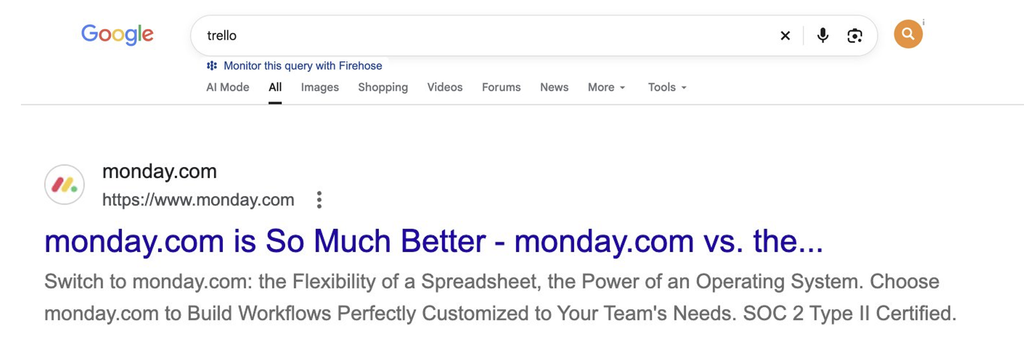
It stopped me in my tracks – and that’s the point. Search is the last place most marketers think copy or creative matter. It’s treated as a bidding exercise: pick keywords, set budgets, count clicks. Yet here was a single line of copy that turned a rival’s brand search into not only an emotional reaction (which we should aim for with every ad) but also a contextual, head-to-head pitch against the brand that had the larger share of “brand awareness” in my mind at that very moment.
This experience summed up one of my biggest beliefs: Impact and context matter as much as targeting & reach. An impression only tells you an ad had the chance to work. Whether it actually works is heavily impacted by whether it was made for the context it appears in.
Below we’ll unpack the data and results around a few campaigns across search, YouTube, mobile, TV, social and outdoor and at the end we’ll highlight what they all have in common.
An Impression is not an Outcome
Many media plans today are judged on reach: how many people could have seen the ad. But “could have seen” does the heavy lifting in that sentence.
Our industry regularly quotes that around 80% of digital ads are “viewable” – the standard for display is just 50% of the ad’s pixels on screen for one second. Eye-tracking firm Lumen Research (UK) found that roughly 70% of digital ads are never looked at at all. By their maths, that’s about £700,000 of every £1 million spent going on ads that nobody sees.
Attention researcher Professor Karen Nelson-Field adds a second problem. Her research found that the first view of an ad produced the greatest impact, with repeat views not necessarily improving results.
Fit Drives Impact, Context Drives Fit
One ad slot can either be a game of chance or it can be decisive. What decides it is the following: where the person is, what they’re doing, and what’s on their mind when the ad appears.
Every campaign below bought a fairly ordinary placement – a search result, a skippable pre-roll, a billboard, an ad break. None of them won by buying more impressions than their competitors. Several bought cheap, unglamorous or no paid media at all.
Search: Even the (Seemingly) most Mechanical Channels Reward Contextual Creative
Someone typing “trello” into Google is weighing up a project management tool right now, and Trello is already on their mind. A generic ad – “Project management software, free trial” – would compete on price and features. Monday.com’s headline does something smarter: it answers the comparison already happening in the searcher’s head. Same keyword, same ad slot, completely different impact. Whats even more interesting, is that Trello had already won the “front-of-mind” awareness battle – Monday.com essentially using their competitors brand awareness against them.
Snickers: Buying the Searches Nobody Wanted (UK, 2013)
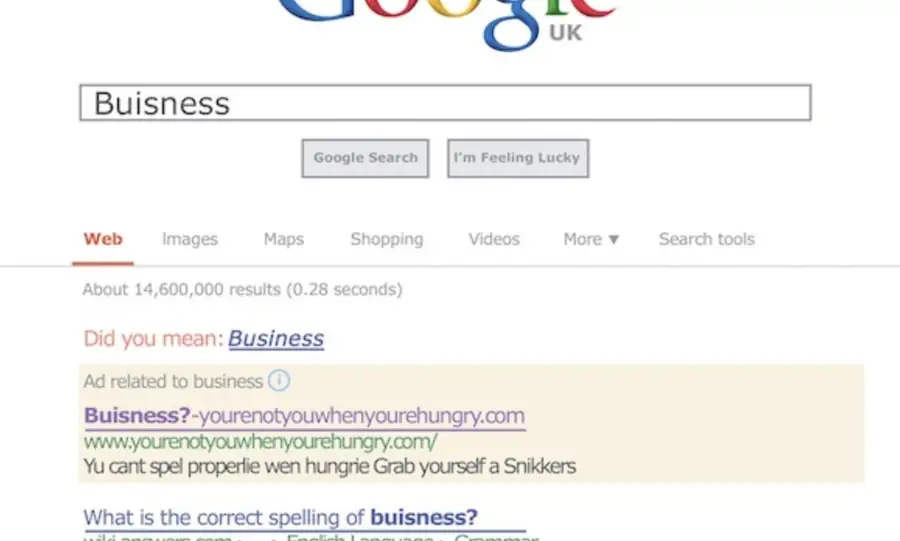
In 2013, AMV BBDO and Snickers worked with Google on an idea built around the famous line “You’re not you when you’re hungry.” Starting from the top 500 search terms, an algorithm generated 25,381 common misspellings – “wether”, “gool”, “definately” etc. Snickers bought those searches and answered each one with an ad suggesting the searcher was too hungry to spell.
Back then (before the introduction of broad match etc.) these typo keywords were inventory most advertisers would never have touched – making them significantly cheaper to bid on. Over three days it delivered 558,589 impressions and a 1.05% click-through rate. At the time, Mediacom’s Lucy Mitchell said she’d expected less than 0.1%.
Understanding your platform unlocks opportunities to use it creatively
Google is traditionally considered a bottom of funnel channel, however this campaign was built for brand awareness rather than clicks; the click-through rate simply shows how many people (actually) noticed. (Search Engine Watch)
YouTube and Mobile: Designing for what People are Actually Doing
GEICO “Unskippable”: writing for the skip button (US, 2015)
Pre-roll viewers aren’t watching the ad. They’re watching the countdown to “Skip Ad”. The Martin Agency’s research put the skip rate at 96% once the button appeared after five seconds.
Instead of fighting that behaviour, they wrote for it. Each GEICO spot delivered the whole pitch inside those five seconds, so the ad was over before anyone could skip it. Then the camera kept rolling on actors holding frozen poses while chaos unfolded around them – most famously, a frozen family dinner while the dog eats their spaghetti.
The “Family” spot passed 8 million views, with full plays the agency described as far higher than normal. Adweek named it Campaign of the Year 2015, and it won the Cannes Film Grand Prix – for a pre-roll ad on youtube. GEICO said its mobile volumes were at record levels and the campaign was a big part of that, though no figures were published. (The Martin Agency)
Burger King “Whopper Detour”: Turning a Rival’s Restaurant into the Ad (US, 2018)
Who is most ready to buy a burger? Someone standing at a McDonald’s. Burger King and FCB New York built a campaign around that context.
In December 2018, the Burger King app offered a Whopper for one cent – but it only unlocked when the user was within 600 feet of a McDonald’s. Burger King geofenced more than 14,000 McDonald’s locations. Customers ordered at the rival’s doorstep, then the app sent them to the nearest Burger King to collect.
The app passed 2 million downloads in 48 hours and hit number one in the App Store’s Food & Drink category within hours. Around 150,000 one-cent Whoppers were redeemed – about four times a normal Whopper offer, according to CMO Fernando Machado – and in-store traffic hit some of the highest levels in Burger King’s history. (Contagious)
Notice that the media placement is the creative idea here. No creative team working alone would have arrived at a geofence, and no media team working alone would have arrived at a one-cent Whopper.
Volvo “The Greatest Interception”: Winning the Super Bowl without a TV Spot (2015)
On 1 February 2015, Toyota, Lexus, Nissan, Kia and Fiat each paid around $4.5 million for a 30-second Super Bowl commercial. Volvo didn’t buy one. According to Marketing Examples, it spent about a fifteenth of that budget and still stole the night.
The insight was that during a rival’s car ad, viewers have their phones in hand and the car category is front of mind. So Volvo asked them to tweet #VolvoContest every time a competitor carmaker’s ad aired, naming someone who deserved a new Volvo XC60. They then executed a car giveaway on Jimmy Kimmel Live two days before launched the contest.
The campaign drew 55,000 tweets and around 230 million media impressions. Volvo was the only automaker to trend globally, and XC60 sales rose 70% year on year the following month. (WARC)
Zero paid Super Bowl impressions, and the most impact of any car brand that night.
Outdoor: Ads that Only Make Sense where they Stand
British Airways “Look Up”: A Billboard that Knew what was Overhead (London, 2013)
Piccadilly Circus and the M4 towards Heathrow sit under busy flight paths, and people naturally look up when a plane passes. Ogilvy and British Airways turned that habit into the ad.
Digital billboards ran other brands’ ads until a BA flight crossed a “virtual tripwire in the air” built from live plane data. The screen then switched to a child pointing up at the actual BA plane overhead, with its flight number and destination, and sometimes the fare. Cloud-height sensors switched the boards off when cloud was too low to see the plane – the ad only ran when its context was real.
Over six weeks from November 2013, the campaign reached an estimated 350 million people in person and online, the launch film hit about a million views within weeks, and BA saw a significant uplift in traffic to its booking site. (D&AD)
The Evidence: The Same Ad does More in the Right Context
These aren’t just award stories. Research points the same way.
In June 2022, Integral Ad Science and eye-tracking firm Tobii compared display ads shown in a relevant context against the same ads out of context. In-context ads were:
- noticed in 0.4 seconds, against 1.0 second out of context — about 2.5 times faster
- four times more likely to be recalled unaided
- linked to 14% higher purchase intent
- linked to 5% higher brand favourability
(IAS – Disclaimer: sample size not published)
The bigger finding comes from Nielsen. Its 2017 analysis of nearly 500 consumer goods campaigns found creative quality drove 47% of the sales lift an ad delivered. Media reach, targeting and recency together drove 36%, and brand factors 15%. (MarketingCharts)
Nielsen put the context of the ad placement on its own at just 2%. That sounds like it argues against everything above, but it does the opposite. A relevant placement on its own does very little. The impact comes when the creative is made for that placement – which is exactly what every campaign in this article did.
What they All Have in Common: They Started with the Audience
Look back over these campaigns and one thing connects them. None started with the channel, and none started with the product. Each started with a question about the audience: what do they need, and what will they be doing at the moment they see this?
- Snickers knew hungry people mistype.
- GEICO knew pre-roll viewers were waiting to skip.
- Burger King knew someone at a McDonald’s already wanted a burger.
- Volvo knew car fans were watching rival ads with their phones in hand.
- British Airways knew Londoners look up when a plane passes.
The channel and the creative were both answers to that same audience question.
Three Ways to Plan a Campaign
In our experience, not all campaigns are planned this way and can often start in one of two other places:
| Approach | Starts with | Then | What you get |
|---|---|---|---|
| Channel first | “Where does this audience consume media?” | Product-led ads are made to fill those placements | Reach, but less relevant and no chance of emotional reaction |
| Idea first | “We’ve got a great creative idea.” | Media is planned afterwards to carry it | Potential emotional reaction but only if relevant |
| Audience first | “What’s their pain point, and what will they be doing when they see this?” | Creative and media shape the idea together | Work that makes sense in its moment and achieves an emotional reaction |
Even arge media agencies often default to the first. Many creative agencies default to the second. Every campaign in this article is the third kind.
Why Creative and Media should be Planned Together
You can’t start with the audience if the people who understand the audience and the people who make the idea never meet. In many cases, they don’t.
Until the 1990s, full-service agencies handled both the creative idea and where it ran. As channels multiplied, holding companies spun media out into separate businesses – many of them now the large media agencies we know today.
Some in the industry argue the split was driven more by margin than by strategy. (The Media Online, opinion) Whatever the reason, the result is a process where creative is often briefed and produced before the media team sees it, and media is planned before anyone asks about the message.
Research suggests this costs effectiveness. In their IPA analysis Media in the Digital Age, Les Binet and Peter Field found that campaigns using online video alone lifted very large business effects by 25%, TV alone by 33%, and the two together by 54%. (System1) Media choices change what creative can achieve, and creative changes what media can achieve.
Clients have noticed.
In 2014, Pernod Ricard’s global marketing head Martin Riley launched a worldwide review of how to bring its media and creative partners closer together, arguing that media planning had become too siloed. In his words: “You can’t divorce it from the content and the creativity.” (AdNews)
Go back to the campaigns above and you’ll see why. In Whopper Detour, “Look Up” and Volvo’s interception, the media mechanic was the creative idea – a geofence, live flight data, a rival’s ad break. Snickers’ later “Hungerithm” in Australia, which dropped the price of a Snickers at 7-Eleven as the internet got angrier, is the same story. None of these could have come from a creative team or a media team working alone.
Start with the audience
Understanding your audience is everything. Not just who they are and where they consume media, but what they need and what they’re doing at the moment your ad reaches them.
Before anyone writes a word of copy or books a single placement, ask three questions:
- What is the audience’s pain point?
- What will they be doing when they see this?
- What could only make sense in that moment?
Then get your creatives and buyers in the same room to answer them together, before anything is made. Impressions tell you an ad had the chance to work. Understanding the audience’s moment can often decide whether it does.
Further reading and sources
Audience-first planning isn’t a new idea. The industry knew it, then organised itself in a way that made it hard to achieve.
| When | Who | The idea |
|---|---|---|
| 1968 | Stephen King (JWT) and Stanley Pollitt (BMP) | Created account planning to put consumer understanding at the start of every brief |
| 1998 | Jon Steel, Truth, Lies and Advertising | The classic book on keeping the consumer at the centre of agency work |
| 2016 | Clayton Christensen et al., Competing Against Luck | “Jobs to be done”: understand the job people hire a product to do, in its real context |
| 2022 | Jenni Romaniuk, Category Entry Points in a B2B World | Plan around buying situations: who, what, when, where, why – and what buyers are doing while they buy |
| Ongoing | Mark Ritson, Marketing Week | Research and strategy first, tactics and channels last |
Sources
- Lumen Research via ExchangeWire – attention vs viewability
- StopPress: Karen Nelson-Field – attention research
- Search Engine Watch – Snickers misspellings campaign
- The Martin Agency – GEICO “Unskippable”
- Contagious – Burger King “Whopper Detour”
- WARC and Marketing Examples – Volvo “The Greatest Interception”
- D&AD – British Airways “Magic of Flying”
- Integral Ad Science – context and attention study
- MarketingCharts – Nielsen creative vs media study
- HBS Working Knowledge – the milkshake story
- The Media Online – the creative/media split (opinion)
- System1 – Binet & Field, Media in the Digital Age
- AdNews – Pernod Ricard
- Campaign Brief – Snickers “Hungerithm”
Image credits
All campaign images are reproduced for the purposes of criticism and review. Copyright remains with the brands and agencies named.
| Image | Brand | Agency |
|---|---|---|
| Search for “trello” | monday.com | Author’s screenshot |
| “Hungry Search” | Snickers (Mars) | AMV BBDO |
| “Unskippable” | GEICO | The Martin Agency |
| “Whopper Detour” | Burger King | FCB New York |
| “The Greatest Interception” | Volvo | Grey New York |
| “Magic of Flying / #lookup” | British Airways | Ogilvy |
Start with your audience
Tell us who you are trying to reach and we will show you how we would plan creative and media together for them. A senior team member will reply within one business day.